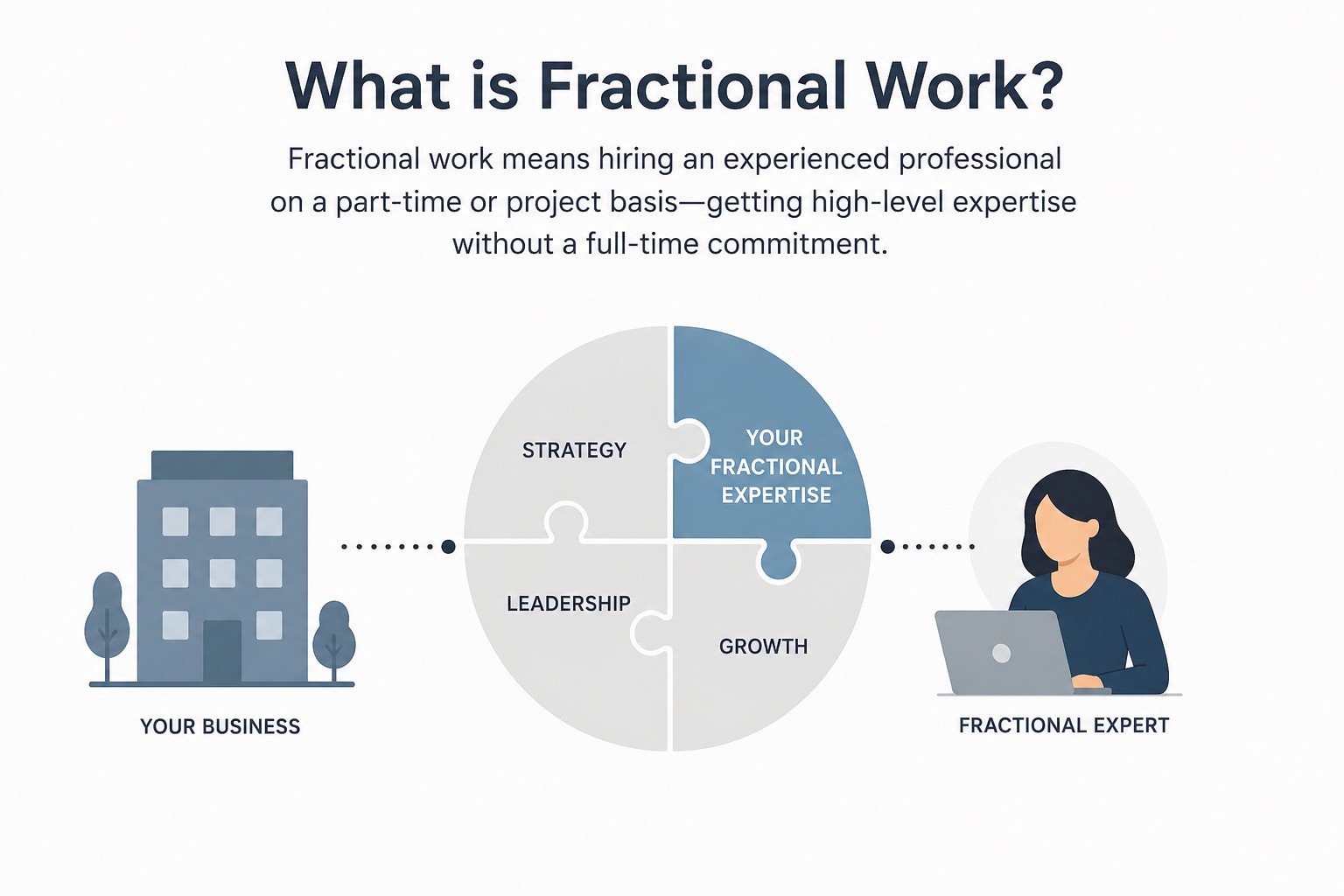
While all three of these roles provide strategic leadership, their duration, depth of engagement, and purpose can vary.
Here’s how:
- Full-time: A regular C-suite member, they come with the expected salary, benefits, and bonuses. They're ideal for companies needing continuous oversight and dedicated strategic input. Companies usually hire a full-time professional when they’re in the £10-50 million revenue range, due to increasing complexity. They may also be onboarded in later-stage funding rounds as per investor terms.
- Interim: Serving as a bridge, they temporarily fill the void when a full-time employee departs, until a permanent one steps in. Their role is typically full-time but short-lived, addressing pressing needs during transitions.
- Fractional: While they can emulate a full-time person’s responsibilities, a fractional professional can also tackle specific functional tasks at a reduced cost. They offer greater flexibility and can also step into interim roles when needed. They are typically engaged for longer durations than interims..
How a Fractional professional Can Help Small to Mid-sized Businesses
1. Optimising Cash Flow
Managing cash flow is critical for small businesses. A fractional CFO for instance brings clarity by implementing effective cash flow strategies that help businesses stay liquid and ready for growth. This includes forecasting, optimising payment terms, and managing working capital.
2. Developing a Growth Strategy
A fractional professional can help craft a strategy tailored to your growth goals. Whether you're looking to expand operations, launch new products, or scale your business, their experience ensures you have a clear roadmap that aligns with your current capabilities.
3. Securing Funding
Accessing capital is essential for scaling, and fractional CFOs have the expertise to guide you through this process. From helping you prepare financial documents for investors to negotiating with banks, a fractional CFO ensures you're positioned for successful fundraising...
4. Compliance Assistance
Navigating regulatory requirements is complicated for any business, but particularly for small businesses. A fractional professional ensures you're compliant with laws, while also identifying opportunities to reduce compliance gaps through strategic planning.
5. Cost Control and Budgeting
A fractional CFO implements stringent budgeting processes to ensure that your business operates efficiently. By developing detailed budgets and cost controls, they help you avoid unnecessary spending and maximise profitability.
And if you’re wondering when the right time to bring on a fractional professional is, read on—there are some clear signs it might be sooner than you think.
When Should You Hire a Fractional professional?
You should consider leveraging fractional professional services if:
- You need someone in a functional leadership position but don’t have the budget for a full-time role or prefer to collaborate with someone temporarily.
- You need a functional expert to establish frameworks for monthly, quarterly, and annual cycles of activity.
- Your board of directors needs support, for example, with evaluating strategic initiatives and investments while avoiding conflicts of interest.
- You want expert help with a specific project or initiative, for example, navigating private equity deals or cash flow management.
- You are entering a new market or pursuing vertical integration and need to evaluate the overall impact of the expansion.
- You are expanding internationally and must navigate the complexities of inter-country accounting, taxation, and compliance requirements.
- You are onboarding fresh equity partners and need a functional expert to evaluate, negotiate, and manage the process.
- You are raising equity capital and need a financial expert to design and present financial projections to investors, ensuring the terms are favourable.
- Your start-up is contemplating an IPO within the next 12-18 months.
- You are experiencing rapid growth, and planning and analysis have become more complex and time-consuming for you and your internal team to manage.
- There is a transition or state of flux where a team is no longer in place to handle operations, but stability and visibility are required.
What Critical Services Do Fractional professionals Offer?
A fractional professional offers a spectrum of services, spanning from developing strategies and optimizing efficiencies to navigating risks throughout the growth stages of the business. They would also be in charge of delivery, overseeing the functional performance in operations of a company, ensuring accurate reporting, and compliance with regulations.
These are the 13 essential outsourced services you can expect:
1. Optimise Processes
As companies expand, their processes may become too complex for the founders to manage without the help of an expert. Growth should never outpace Control!
Fortunately, a fractional professional can oversee, standardize, and refine your processes. This way, you can confidently address other critical aspects of your enterprise or small business without neglecting other priorities..
Streamlining processes ensures consistency, and enhances the overall efficiency of your business operations
2. Create Budgets and Financial Forecasts
Your bookkeeper, accountant, or controller may only oversee historical financial data. On the other hand, a fractional CFO specializes in budget planning and financial forecasting as well.
- Budgeting: They will craft a well-informed budget that outlines your financial goals and formulates a detailed action plan. This plan includes allocating resources effectively, estimating revenue streams, and setting clear financial milestones.
- Forecasting: They will use their market knowledge and your company’s historical performance data to predict future financial results using specialized software and data analytics. They’ll also use this financial information to set goals, track performance, and adjust strategies as needed.
A financial forecast and budget can help your stakeholders make informed decisions. They also act as performance benchmarks for investors.
3. Reporting
Beyond time constraints, business owners require precise insight to make informed decisions.
Fortunately, reporting is one of the core fractional professional services.
Fractional professionals track financial and non financial KPIs (key performance indicators) to draw up comprehensive reports, painting a clear picture of your company's overall performance health. They would present the data on intuitive dashboards, allowing top management to view key insights for daily operations as well as monthly and quarterly trends.
As part of their role, they would ensure the accuracy and compliance of every report, safeguarding the business from potential discrepancies and regulatory pitfalls.
Beyond just crunching numbers, a fractional professional can also see the bigger picture to quickly identify areas of the business that need immediate attention, enabling you to remedy the situation quickly.
In essence, a fractional professional plays a crucial role in transforming raw data into strategic business intelligence. Plus, it will influence future decision-making and strategies.
4. Enhance Strategy and Compliance
Regulations are not only intricate but also constantly shifting, presenting a challenge even for seasoned in-house teams to stay abreast.
For instance, a manufacturing firm expanding overseas might neglect specific international tax considerations.
With a fractional professional’s strategic guidance, companies can leverage potential benefits, ensuring compliance and cost-efficiency.
5. Ensure Compliance
If compliance measures aren’t managed well, your company will end up with discrepancies and regulatory penalties, and may lose stakeholder trust.
Fortunately, a fractional professional can adeptly take charge of compliance responsibilities. For instance, they can:
- Ensure compliance with regulatory body standards and requirements
- Maintain regular and open communication with internal and external bodies
- Outline the scope, timelines, and goal of any audits
- Conduct a pre-audit to identify and rectify discrepancies
- Provide training and resources to the teams for effective support
- Clarify roles and responsibilities within the teams during any audits
- Appeal requested modifications and fines when needed
- Review the process and identify improvements post-audit
This way they ensure that your existing practices meet the established standards and successfully pass external and internal reviews.
6. Strategic Planning
A fractional professional's strategic planning is crucial for aligning operational and business goals. Without it, your business could be overlooking valuable opportunities, using resources inefficiently, and heading in the wrong direction.
They will use data to set goals and create the blueprint to achieve them. With the company’s vision in mind, they’ll assess its overall position, and identify opportunities and threats in the market. They would collaborate with other senior executives to drive cohesive decision-making.
For instance, a fractional marketing specialist may detect that the root cause for declining sales is lower investments in the marketing function in comparison with benchmark companies. They would then work with your marketing and sales teams to allocate higher budgets.
Or, if a cybersecurity tech start-up in the UK wants to expand into Europe, a fractional cyber security expert may leverage their industry knowledge and analyse the costs and returns of the existing strategy.
The result?
They may suggest prioritizing the Asia Pacific market, projected to surge in the short term. This way, the start-up can tap into the booming Asia Pacific market while sidestepping Europe's regulatory challenges.
7. Treasury Management
Without proper treasury management, a company can face liquidity crises, be exposed to financial risks, and miss out on profitable investment opportunities.
The role of a fractional CFO is pivotal here.
A fractional CFO can provide invaluable insights into your liquidity profile and manage cash flow while positioning your company for future growth.
By building strong relationships with financial institutions, they can secure favourable financing terms. For instance, they might negotiate short-term loans with banks, allowing your company to capitalise on a sudden market opportunity without draining cash reserves.
They will also optimise your firm's capital structure, ensuring you're strategically leveraging debts and investments to maintain financial flexibility.
Moreover, through effective financial analysis, a fractional CFO will coordinate with your leadership team to pinpoint areas in each vertical of the company that could benefit from optimisation. This could involve trimming redundant or unused services, switching to yearly billing to capitalize on long-term savings, or taking advantage of available credits and discounts.
Owing to this fractional CFO service, your business’ liquidity will improve resulting in a financially stable and agile organisation, poised for growth and shielded from volatile market conditions.
8. Raise Capital & Build a Fundraising Strategy
Securing funding is pivotal for start-ups eyeing sustainable growth.
Fortunately, business owners can navigate the intricacies of the fundraising landscape effectively with a seasoned team that includes a CFO but also other functional experts to build the fully rounded business case. Their expertise goes beyond mere navigation - they can also help you align your capital-raising strategies with company objectives.
In such a challenging funding environment, a fractional team can:
- Evaluate a range of potential venture capital sources
- Leverage financial forecast data to instil confidence in potential investors
- Establish and nurture relationships with potential investors
- Craft compelling investor pitches and presentations
- Establishing a data room for investors or acquirers
- Assisting in due diligence questions that arise
- Creating and pre-answering questions from prospective capital partners
Together, these actions will increase your odds of securing crucial venture capital in a challenging environment.
9. Vendor Negotiation and Contract Optimization
Navigating vendor relationships demands more than just basic negotiation skills. It requires a deep understanding of industry benchmarks, prevailing market rates, and strategic foresight.
By revisiting contracts and aiming to reduce costs, often targeting a reduction of up to 20%, a fractional procurement expert can drive immediate cash savings.
For instance, upon assessing a company's annual software licensing agreement, a fractional procurement leader may renegotiate terms with the vendor, consolidating multiple licences and eliminating redundant features, leading to huge savings in annual software costs.
Over time, such strategic renegotiations compound, positioning the business for sustainable growth and competitive advantage in the marketplace.
10. Implement and Scale New Systems
Transitioning to a new software to streamline your processes can make your team apprehensive, fearing the shift might interrupt their daily tasks and disrupt the ways of working.
In such situations, an outsourced IT systems professional will collaborate with your team, ensuring a smooth rollout. This involves hands-on training sessions, tweaking the software to automate workflows, and running pilot tests to pre-emptively catch and fix any glitches before they affect your operations.
Once the system is implemented, the savings in time and cost of automation can be redirected towards company expansion, talent acquisition, and other growth initiatives.
11. Guide Mergers and Acquisitions
When venturing into mergers or acquisitions without expert guidance, companies can risk overpaying, miss potential liabilities, or fail to realise the projected synergies.
A fractional cross functional team brings invaluable depth to such complex processes. They don't just oversee finances but also HR, Legal, Operational, Commercial and IT considerations as they delve deep, ensuring every facet is scrutinised for decision-making.
Here’s how:
- Mergers: Imagine two software companies merging to leverage each other's strengths. A fractional IT expert could identify redundancies in software licences, ensuring that the merged entity doesn't double-pay for similar services, optimising operational costs and boosting profitability post-merger.
- Acquisitions: If your company wants to acquire a start-up, a fractional legal expert thorough analysis might reveal unresolved litigations. This revelation could prompt a reassessment of the acquisition's viability or even a decision to abandon the deal, potentially saving your company millions.
- Data Room Management: A fractional team, with their collective comprehensive understanding of what potential investors or buyers seek, can meticulously organise and manage data rooms (repositories for due diligence information). By ensuring that all pertinent data is presented clearly and securely, they facilitate smoother and more transparent transactions.
12. Adhere to New Regulations
You need to proactively update your processes and policies to comply with changing regulatory requirements. Otherwise, your company faces the risk of penalties, and damage to reputation.
Thankfully, a fractional team will be equipped to navigate these complexities and ensure compliance.
13. Mentoring and Training
Many companies are turning to fractional experts to mentor their teams, especially in smaller organisations where in-house expertise may be limited.
Here's how this mentorship may work:
- Direct Strategic Guidance: ambitious members eyeing C Suite level benefit from direct interactions, gleaning insights from a seasoned professional.
- Expert Responses: Queries from the broader executive team are addressed with grounded, real-world experience.
- Elevated Standards: Aligning with practices from mature enterprises, a fractional expert brings the discipline and standards of a later-stage company. This imparts an institutional strength to the team, proving invaluable for growth and sustainability.