March 26, 2026

Why Cross-Functional Teams Accelerate Results
Perhaps the greatest weakness of traditional consulting, interim management and individual
fractional appointments is that they often approach challenges through a single lens.
A Finance Director naturally views issues through a financial perspective.
An Operations specialist focuses on process and efficiency.
A Commercial Director concentrates on revenue growth and market opportunities.
While each perspective is valuable, real business challenges rarely exist in isolation.
Consider a business looking to double its revenue over the next three years. At first glance, this appears to be a commercial challenge. In reality, achieving sustainable growth may require:
• Financial modelling and funding strategies
• Sales process optimisation
• Marketing effectiveness
• Operational capacity planning
• Supply chain resilience
• Technology enablement
• Leadership development
• Recruitment and workforce planning
No single specialist can realistically provide deep expertise across every one of these disciplines. A multi-disciplinary fractional services partner can.
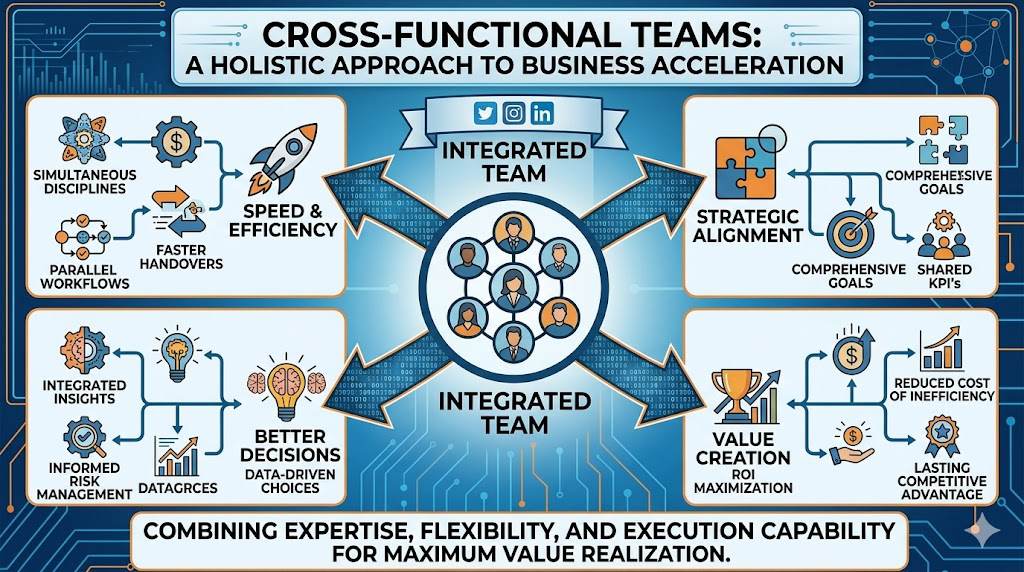
The ability to introduce additional specialists precisely when needed creates a powerful advantage for clients. Rather than working sequentially through challenges, businesses can tackle multiple aspects of growth or transformation simultaneously.
This dramatically accelerates progress. Instead of finance identifying a problem and then handing it over to operations, who then involve HR, who later engage technology specialists, a cross- functional team can work collaboratively from the outset.
The result is faster diagnosis, better decision-making and more effective implementation.
The Power of Integrated Thinking
One of the most significant benefits of a cross-functional team is the ability to connect decisions across the organisation.
For example, a proposed growth initiative may appear highly attractive from a sales perspective. However, a finance specialist may identify cash flow implications, an operations expert may highlight capacity constraints, and an HR professional may identify skills shortages that could limit execution.
By bringing these perspectives together early, businesses make better-informed decisions and avoid costly surprises later. This integrated approach often uncovers opportunities that would otherwise remain hidden. It also ensures that growth plans are not only ambitious but achievable.
Building the Right Team at the Right Time
Another significant advantage is flexibility. Clients do not need every specialist all of the time. They need the right expertise at the right moment.
A sophisticated fractional services business can assemble and deploy resources according to the specific requirements of each stage of the journey.
An engagement may begin with strategic planning and financial analysis. As priorities become clearer, operational specialists, technology experts, commercial leaders or transformation professionals can be introduced to support delivery. This provides clients with access to executive-level capability without the cost of maintaining a large permanent leadership structure. More importantly, it ensures that expertise is aligned directly to outcomes rather than organisational hierarchy.
From Advice to Execution
Many organisations have no shortage of advice. What they often lack is coordinated execution. A cross-functional fractional team bridges the gap between strategy and delivery.
Because specialists work together around a common objective, they can move beyond identifying issues and focus on implementing solutions. The finance team can build the business case. Operations can redesign processes. Technology specialists can enable automation. Commercial leaders can drive revenue growth. HR professionals can ensure the organisation is equipped to sustain the change.
The result is not simply better recommendations. It is faster implementation, stronger accountability and measurable business outcomes.
For organisations seeking growth, transformation or performance improvement, this ability to
combine expertise, flexibility and execution capability is often where the greatest value is realised.